
Asphalt Repair and Patching in Riverside, CA
Elite Riverside Asphalt fixes pavement that is failing without being finished: potholes, alligator cracking, sunken low spots and raveling edges on driveways, private roads and commercial lots across Riverside. Asphalt repair means taking out the areas that have actually let go, rebuilding what is under them and patching back, instead of tearing out a surface that still carries load. It is licensed work in California under the C-12 earthwork and paving classification, which covers the mixing, fabricating and placing of paving materials.
Our hot mix comes from Inland Empire plants and goes down to Caltrans Standard Specifications Section 39, and every failure area is recorded with ASTM D6433 distress terms so the written scope names a method per area rather than one price. When a surface is too far gone for pothole repair and patching to make sense, the honest answer is asphalt resurfacing, overlay and milling, and we say so at the estimate.

Get a Free Asphalt Paving Quote
Square footage, base condition, thickness and tear-off decide most of your price. Tell us the property address, the job type (driveway, parking lot or repair) and a rough size, and we call back within one business day to schedule a free on-site measurement.
Asphalt Repair Types We Handle in Riverside
Asphalt Driveway Repair
A residential driveway usually arrives with three problems at once: holes near the apron, spiderweb cracking in the wheel paths and a soft spot that dips under a parked car. Our estimator probes or cores the mat to learn its real thickness, checks whether the aggregate underneath is saturated, and reads the slope toward the street, because a drive that sheds water backward keeps feeding its own base. Most single drives are a one day job for our crew: cut, break out, recompact, place hot mix and roll it. Rolling is exactly what a bagged cold patch from a home center never gets, and insufficient compaction is itself a documented cause of the fatigue failure the owner is trying to fix. A hand tamper cannot reach the density a vibratory roller does. If the mat is too thin and too broken to save, we quote asphalt driveway paving instead.
Asphalt Patching: Surface and Full-Depth Patches
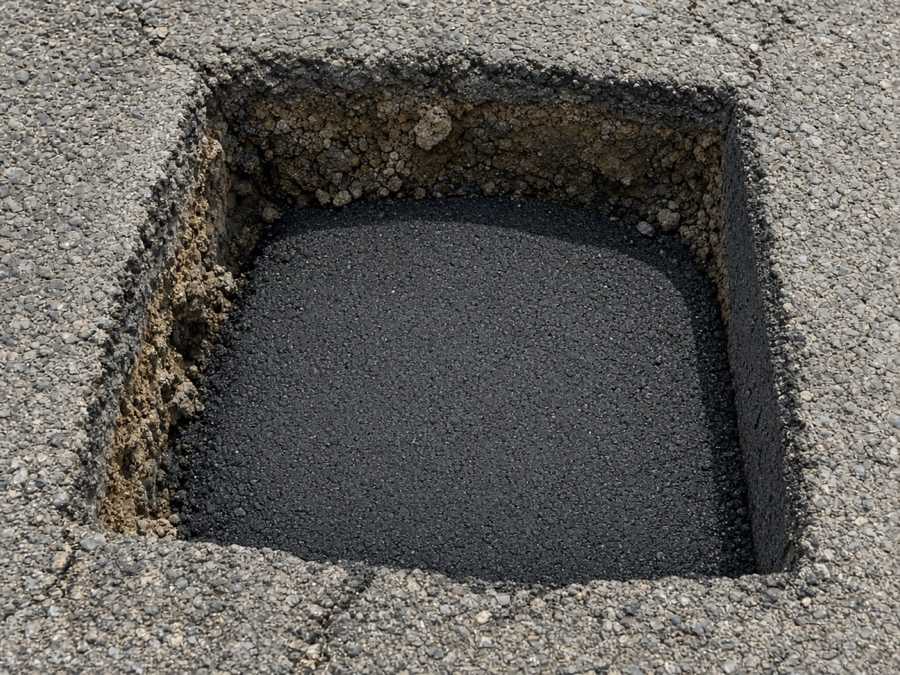
Asphalt patching comes in three depths, and the failure decides which one you need. A skin or surface patch lifts roughly the top inch to inch and a half where the mat has worn but the structure below is intact. A throat, or partial depth, patch reaches further into the bound layers and stops above the aggregate. A full depth patch takes the whole section, commonly three to four inches of pavement here, plus the compromised base beneath it. All three begin with a square vertical edge and a tack coat sprayed on that face before mix goes in. Thin work also has a floor: a lift must be at least three times the nominal maximum aggregate size before it will compact at all. An unbonded joint is where an inland summer finds you, since a softened mat around a loose edge travels under traffic and the patch lifts out.
Pothole Repair Service
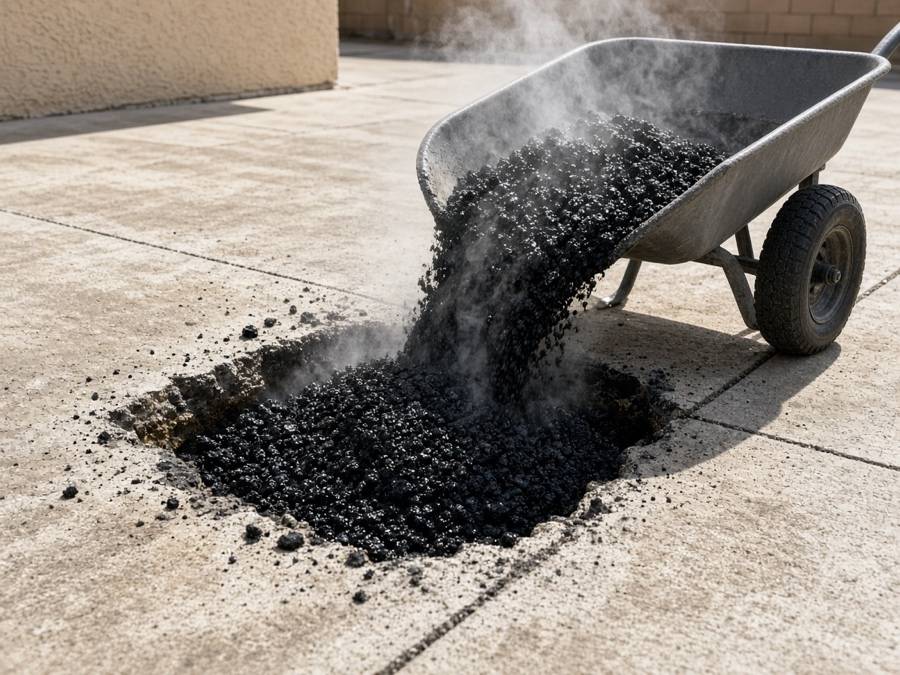
A pothole is what a crack becomes once water gets past it. Moisture infiltrates through the cracking, the aggregate below loses its support, and the surface punches through under the next loaded axle. That is why throw and go cold patch pops out within a season: it goes in cold, into a dirty hole, and never reaches density, so tires pump it straight back out. A permanent pothole repair on private property saws back to sound pavement, dries and cleans the void, recompacts or replaces what is under it, then places hot mix in lifts and rolls each one to 92 percent of theoretical maximum density with no test below 90 percent. The mix has to land hot, not under 250 F at the paver, and it cannot be placed on a wet surface. The City crews look after public streets; we take lots, drives and private roads, generally within the same week.

Infrared Asphalt Repair
Infrared asphalt repair reheats the pavement you already own instead of cutting it away. The heater brings the existing material back to its original application temperature of 350 degrees Fahrenheit in roughly 8 to 10 minutes, working 1.5 to 2.5 inches down, with the unit set to cover a minimum 3 inch perimeter past the failure. Our crew then scarifies the full heated depth, frames the edges first, works in rejuvenator at 0.12 gallons per square yard, adds fresh hot mix where material is missing, levels the panel about a quarter inch proud of grade and compacts it. Nothing is cut, so no cold joint exists to open later. That makes it right for seams, birdbaths, the edges of old utility patches and shallow holes. It is wrong for any failure that began underneath, where reheating the top only buys a season.
Full-Depth Asphalt Removal and Replacement
Once the ground beneath has failed, full depth asphalt removal and replacement is the repair that actually holds, because a fatigued surface contributes minimal structural strength to whatever you build on top of it. We cut the failed area square, excavate the pavement plus the aggregate that has been compromised, and haul it off; the old material returns to the plant as RAP, which Caltrans allows back into a mix at 15 percent as a baseline and up to 25 percent on an approved job mix formula. The subgrade is regraded, moisture conditioned, recompacted to a proctor target and proof rolled. Paving back goes in lifts of not less than 0.15 foot with tack between them. Expansive clay and inland heat push our standard section deeper than a coastal one. Trench and utility cut restoration is this same scope on a narrower footprint.
Asphalt Damage We Diagnose and Repair
Alligator Cracking and Fatigue Failure
Interconnected, many sided cracking is fatigue failure of the surface under repeated traffic loading, not a cosmetic problem. In a thin mat the cracks begin at the bottom of the layer, where tensile stress peaks, and travel upward until they join into the familiar hide pattern. The cause sits lower down: lost support, stripping, or a mat never brought to density. ASTM D6433 is the condition survey standard the trade uses to log it. Alligator cracking repair therefore starts below grade, and those areas come out to base.
Sunken Areas, Raveling and Crumbling Asphalt Edges
Three distresses, three separate causes. A sunken low spot means the material beneath washed out, or a leaking irrigation line has been soaking it for months along a landscaped frontage, and the damage compounds when nearly all of Riverside's 9.39 inches of annual rain arrives between November and April. Raveling is oxidation: the binder hardens, releases its aggregate, and the top goes rough and loose. Crumbling edges break away where no curb or shoulder confines the mat, so asphalt edge repair has to restore that confinement.
Our Asphalt Repair Process, Step by Step
Pavement Assessment and Free On-Site Measurement
The free on site measurement is a survey rather than a walk around. We take the square footage of each failure separately, probe or core the existing thickness, judge what the pavement is sitting on, trace where water runs, and measure gate and access width. Every distress is logged with the ASTM D6433 vocabulary, so your written asphalt repair estimate can state a method, a base depth, a compacted thickness and a tonnage for each area instead of one lump sum.
Saw Cutting, Removal and Base Repair
Removal begins with a clean vertical saw cut on square edges, giving new mix a face it can bond to rather than a feathered lip that ravels. The broken section is loaded out the same day. We then regrade the exposed aggregate, import more where the layer is short, and compact each lift to at least 95 percent relative compaction. Where the subgrade stays soft under a proof roll, geotextile paving fabric goes down first.
Compaction, Cure Time and Returning to Traffic
Hot mix returns in lifts and takes a set rolling pattern: three vibratory coverages, three pneumatic coverages at no more than 5 mph, then one steel tired finish coverage. Nothing opens until mid depth temperature drops below 160 degrees F. In practice you walk on it that afternoon and park light vehicles the following day. Keep turning wheels and trailer jacks off the new surface for a week through summer.
Why Riverside Property Owners Choose Us for Asphalt Repair
- Licensed C-12 asphalt repair contractors, earthwork and paving classification.
- General liability and workers compensation carried on every crew.
- We own the paver, rollers, skid steer planer and crack router.
- No subcontracted crews; the outfit that quotes is the outfit paving.
- Written scope naming a repair method for each failure area.
- Written workmanship warranty covering all of our full depth work.
What Affects the Price of Asphalt Repair in Riverside
Damage Depth: Surface Patch Versus Full-Depth Replacement
Depth drives the number. A shallow patch touches the top inch or two, so it is mostly labor and a little tonnage. Taking the same square footage out full depth also buys excavation, haul off, imported aggregate and compaction. Statewide California patching averages about $3.00 per square foot, and our asphalt paving cost guide breaks the drivers apart.
Square Footage and the Number of Separate Repair Areas
Six scattered repairs cost more than one area of identical total size. Each carries its own cut perimeter, its own layout, its own compaction pass. Meanwhile the crew, the trucking and the plant load are paid for once either way. Past that minimum mobilization the rate per square foot falls as the areas grow larger and fewer.
Site Access, Traffic Control and Night Work
A narrow gate forces smaller machines and more hand work, which costs hours. Occupied sites get phased so part stays open, the way we run commercial paving and parking lots, with flagging wherever traffic crosses. Night and weekend windows carry a premium. Right of way work needs a control plan and a street opening permit, generally 7 to 10 business days.
Base Condition, Drainage and Existing Asphalt Thickness
Three findings convert a cheap fix into a full depth scope: saturated or undersized aggregate, a broken drain, and an original mat laid too thin. A pan flatter than the 2 percent minimum design slope holds water and keeps the cycle running. None of it shows from above, which is what the core or probe at the estimate is for.
FAQs About Asphalt Repair in Riverside
Can a broken asphalt driveway be repaired?
Yes, when the failure is localized and what sits under it is still sound. We lift the failed areas, replace poor subgrade, improve drainage and patch back. The deciding questions are how much of the surface has alligatored and whether water has already reached the layers beneath. Past that, the section gets replaced.
Will new asphalt stick to old asphalt?
Yes, with a tack coat. Fresh hot mix bonds to aged pavement and to a cut vertical face through a sprayed asphaltic emulsion, applied at 0.08 to 0.15 gallons per square yard of two to one dilution on a clean, dry surface. Skip it and the joint opens.
What is the best way to repair an asphalt driveway?
No single method wins; the right one matches the distress. Narrow cracks under three quarters of an inch belong to crack sealing and filling. Isolated holes get taken out to their full depth. Anything showing the hide pattern is rebuilt, since sealing it is generally ineffective by then.
How long will an asphalt patch last?
A properly compacted full depth hot mix patch should serve as long as the pavement around it. A shallower one is a shorter fix, measured in a few years rather than decades. Heat is what shortens both: across 21.6 days a year at or above 100 F, a weak joint softens and starts moving.
What is the cheapest way to repair an asphalt driveway?
It depends on the failure, and the cheapest permanent answer is rarely the cheapest quote. A hairline crack is trivial to close; an isolated hole still needs its full section removed. What does not last: bagged cold patch above a failed foundation, and asphalt sealcoating over cracking, which restores appearance but fixes nothing structural.
Get a Free Asphalt Repair Estimate in Riverside
Elite Riverside Asphalt covers asphalt repair services throughout Riverside, from one sunken pothole to a full depth lot rebuild. Call [PHONE] for a free on site measurement and a written scope that names the method, thickness and tonnage for every area. You can also send photos and dimensions through our contact us page.