Asphalt Resurfacing, Overlay and Milling in Riverside, CA
Elite Riverside Asphalt resurfaces, overlays and mills asphalt pavement across Riverside, where the surface fails on a schedule the coast never sees. Riverside averages 21.6 days a year at or above 100 degrees F, with a record high of 118 degrees F, and gets 9.39 inches of rain a year, almost all of it between November and April. Heat drives the binder out of the wearing course, then the short wet season finds every open crack. Asphalt resurfacing means placing a new hot mix overlay, after cold milling the old surface first, bonded to a base that is sound instead of a full rebuild. We hold the CSLB C-12 Earthwork and Paving license and follow Caltrans Standard Specifications Section 39 for hot mix asphalt, with South Coast AQMD rules governing paving equipment near the 91 and 60 corridors.
We own our paver, rollers, a skid steer with a planer, and a sealer rig, and run our own crews instead of subcontracting. If your driveway, parking lot or private road in Riverside looks gray and worn but the ground under it hasn't shifted, a mill and overlay is the faster fix.

Get a Free Asphalt Paving Quote
Square footage, base condition, thickness and tear-off decide most of your price. Tell us the property address, the job type (driveway, parking lot or repair) and a rough size, and we call back within one business day to schedule a free on-site measurement.
Asphalt Resurfacing and Overlay Options We Handle in Riverside

Residential Asphalt Driveway Resurfacing
Asphalt driveway resurfacing on a typical Riverside home means placing a 1.5 to 2 inch compacted wearing course over the existing drive instead of tearing it out. Two conditions have to be true first: the base under the asphalt is still sound, and the surface isn't showing widespread fatigue, the alligator-pattern cracking that means the pavement below has lost its structural strength. If both hold, we sweep and power clean the drive, treat any working cracks, apply an emulsion tack coat, then pave the new lift with a paver and rollers. The catch in Riverside is the heat: new hot mix asphalt can't be opened to traffic until its mid-depth temperature drops below 160 degrees F, so on a summer afternoon your car sits off the drive a while longer than the paving itself takes.

Hot Mix Asphalt Overlay for Aging Pavement
An asphalt overlay is a new lift bonded to pavement that is still structurally sound, using an emulsified asphalt tack coat so the two layers act as one rather than sliding apart. Lift thickness runs by load: about 1.5 inches on a residential drive and up to 3 inches where truck traffic crosses the surface. Skip the tack, or apply it thin, and the new mat can de-bond into a slippage failure within a season. Done right, a dense-graded overlay over sound pavement commonly adds 4 to 6 years of service, sometimes up to 10; the same lift over a surface that is already distressed only buys 1 to 3 years, so the honest answer depends on what's under it, not just what's on top.
Mill and Overlay for Grade Sensitive Surfaces
Mill and overlay removes the same depth of old asphalt that we pave back, so the finished surface returns to its original grade instead of stepping up above the curb, gutter, garage apron or door threshold. Milling depth typically runs 1.5 to 3 inches to match the lift going back down. A milled surface also needs about 50 percent more tack than an unmilled one before the new mat goes down, because the grooved texture drinks more emulsion. We call for mill and overlay over a plain overlay whenever a driveway, drive aisle or approach can't afford to gain height without breaking drainage fall or leaving a lip at the threshold. Resetting grade this way also lets us correct a low spot that was ponding water instead of just paving over it, and it keeps a public street approach tied in flush where our work meets the existing road rather than stepping the transition. A plain overlay is faster and costs less, but it only makes sense where the surface has room to rise without creating a new tripping or drainage problem at every edge.
Asphalt Milling and Cold Planing
Asphalt milling uses a rotating drum fitted with carbide cutters to grind away the top of the old surface; the tooth spacing on the drum sets how coarse or fine the resulting texture is. We run half-lane and small cold planers for driveways and lots, and a skid steer planer attachment for aprons and tight residential access a full-size machine can't reach. The grooved surface a planer leaves isn't just a hole cut into old asphalt, it's a bonding surface the new lift keys into once the tack coat goes down. Everything the drum removes is reclaimed asphalt pavement, and it gets hauled off and recycled back into new mix rather than sent to a landfill. Riverside County itself bids micro-milling as a routine four-foot-wide line item on its own pavement programs, which is the same narrow-band approach we use along edges, gutters and approaches rather than milling a whole surface when only a strip needs it. Micro-milling drums carry three to four times as many cutting teeth as a standard drum, leaving a finer texture where a smooth tie-in matters most.
Parking Lot and Commercial Lot Resurfacing
Parking lot resurfacing at an occupied Riverside property gets phased so half the lot stays open while we work, keeping tenants and customers moving during the job. Drive aisles, trash enclosure approaches and truck routes get the heavier compacted section, since those are the paths that see the concentrated load, while stall areas run the standard lift. New hot mix can't take traffic until its mid-depth temperature falls below 160 degrees F, which is part of why phasing matters on a working lot. Once the surface cures, we repaint the stall lines, arrows and any ADA markings so the lot reopens with a layout that matches what tenants and drivers already expect, rather than a blank mat. We schedule the heavier sections and the standard stall areas as separate passes where the schedule allows, so the parts carrying the most weight get their full cure before regular traffic returns to them. For a lot that needs new construction rather than resurfacing, see our commercial paving and parking lots page.
Asphalt Overlay Over Existing Concrete
Placing an asphalt overlay on concrete is standard work, but the joints in the slab underneath will move and telegraph straight through a thin lift unless we plan for it. A thicker section, a geotextile paving fabric interlayer, or a bond breaker over the joints all help, since thin overlays only resist reflective cracking when paired with a fabric interlayer or a similar stress-absorbing layer. Tack over concrete pavement is specified at a minimum of 0.06 gallons per square yard undiluted, the same rate used over existing asphalt, so the bond isn't the weak point when it's applied correctly. We typically won't place less than about 1.5 to 2 inches of compacted asphalt over a slab, and where the joints are badly spalled or the slab itself has shifted, we tell you plainly that removal makes more sense than paving over it. This is asphalt placed over an existing slab; Elite Riverside Asphalt does not pour or finish concrete flatwork.
Edge Milling, Grade Transitions and Apron Tie Ins
Edge milling cuts a defined band, typically 12 to 18 inches wide, along gutters, garage aprons, sidewalks and door thresholds so the new lift feathers down to grade instead of standing proud of the surface it meets. Riverside County itself specifies a four-foot-wide micro-mill item on its own pavement work, the same narrow-band logic we use at a much smaller scale along an edge or approach. Where drainage fall matters, we reset the grade as part of the milling pass, correcting a flat spot or reverse slope rather than paving over it and leaving it to pond. A tie-in at a public street approach is cut with a saw to a clean match line and paved to meet the existing road surface, work that falls under a City of Riverside construction permit when it touches the right of way.
Private Road and HOA Street Overlay
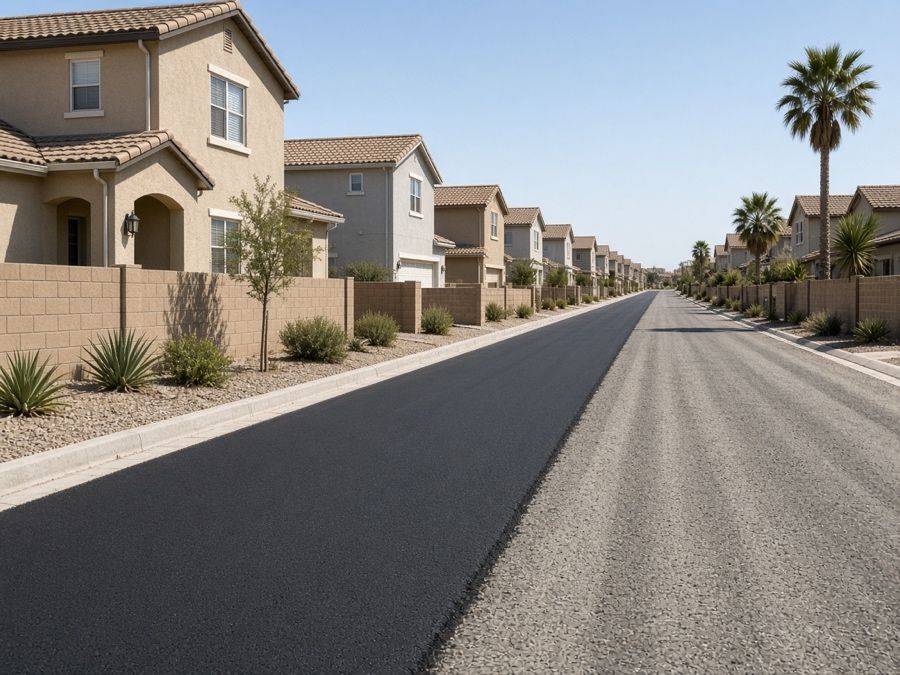
A homeowners association board planning street work usually starts with a condition survey that ranks every street in the community by how much pavement life is left, then budgets a multi-year plan against that ranking rather than approving one job at a time. Riverside County runs its own version of this at scale, with an annual pavement preservation program across its road districts, which is the vocabulary a board picks up when it starts talking to a paving contractor. Overlay life on a private street follows the same condition rule as anywhere else: sound pavement underneath typically buys 4 to 6 years of service, up to 10 in good conditions, while a street that is already failing gets only 1 to 3 out of a thin lift. Because residents live on the street, we phase the work, post resident notice ahead of time, and hold access windows so driveways and guest parking aren't cut off for the whole job.
Our Asphalt Resurfacing Process, Step by Step
Pavement Evaluation: Resurface, Overlay or Replace
Our estimator checks base soundness, looks for fatigue and alligator-cracked areas, probes or cores the existing thickness, and checks drainage fall along with edge and apron condition. The rule is simple: once alligator cracking is widespread, the pavement below has lost most of its structural strength, and an overlay just seals a failure that keeps moving underneath it. When that's the case, we recommend full asphalt driveway replacement instead of resurfacing over it.
Surface Prep, Crack Treatment and Tack Coat
We sweep and power clean the surface, treat any working cracks, cut out and rebuild failed spots, then spray an SS-1h or CSS-1h emulsion tack coat at the rate the surface calls for, 0.06 gallons per square yard on existing asphalt and more on a milled one. That tack rate is what decides whether the new lift bonds to what's underneath it or delaminates the first summer.
Paving Lifts, Compaction and Return to Traffic
We place the compacted lift, then roll it in sequence: three passes with a vibratory roller, three with a pneumatic-tired roller under 5 mph, and one finish pass with a steel-tired roller. On a Riverside afternoon past 100 degrees the mat stays workable longer, but the finished lift needs its core to cool under 160 degrees F before anything drives on it, so cars wait longer than foot traffic and loaded trucks wait longest of all.
Materials and Equipment We Use for Asphalt Overlay Work
Hot Mix Asphalt Mixes and Emulsion Tack Coats
We place fine-graded 1/2 inch and 3/8 inch hot mix asphalt on driveways and lots, using the PG 64-10 binder Riverside County specifies for Inland Valleys work. Tack coats go down as SS-1h or CSS-1h emulsion, the same grades the county calls for on its own fog seal and overlay work. Our mix is sourced from Inland Empire plants and chosen for inland heat, not just for whatever a supplier has on hand that day.
Cold Planers, Pavers and Rollers
Our asphalt paving equipment runs from half-lane cold planers down to a skid-steer planer for aprons and gate throats a full-size machine can't enter, tracked and wheeled pavers for laying the new mat, and vibratory steel-drum rollers for breakdown compaction paired with pneumatic-tired rollers for the intermediate pass. Each machine earns its spot by the width and access it can work in, not by size alone.
Why Riverside Property Owners Choose Us for Asphalt Resurfacing
- CSLB C-12 Earthwork and Paving license, insured with workers comp
- Own our cold planer, paver and rollers, no subcontracted crews
- Compaction tested to a published spec, unlike most asphalt resurfacing companies
- Written scope stating square footage, thickness and tonnage before we start
- Written workmanship warranty on every full-depth overlay
- Callback within one business day, free on-site measurement
What Affects the Price of Asphalt Resurfacing and Overlay in Riverside
Square Footage and Existing Pavement Condition
A published Riverside cost report prices a 2 inch overlay at $2 to $4 per square foot, with local totals of $1,200 to $2,800 for a driveway and $15,000 to $50,000 for a private road. Measured area sets the baseline; the share needing cut-out first moves it more. See our asphalt paving cost guide.
Overlay Thickness and Number of Lifts
The published $2 to $4 per square foot Riverside range ties to a 2 inch compacted overlay. A second lift is a spec decision at 0.30 foot or more, with tack between lifts. Going thinner is the false economy: a skimpy blanket buys 1 to 3 years against 4 to 6.
Milling Depth, Haul Off and Disposal
No Riverside or regional source publishes a milling rate per square foot, so we price this qualitatively. Milling depth matches the lift going back, typically 1.5 to 3 inches, and depth times area sets the tonnage that comes off. Tonnage sets truck loads and hours on site; the millings return to new mix rather than a landfill.
Site Access, Traffic Phasing and Night Work
Access decides the equipment: a tight drive fitting only a skid-steer planer takes longer per foot than a lot a full crew walks into. Phasing a lot so it stays partly open means mobilizing twice, waiting on the mid-depth temperature limit before the second half opens. Night work and right-of-way work each add their own cost.
FAQs About Asphalt Resurfacing and Overlay in Riverside
Is asphalt resurfacing worth it?
Yes, when the base underneath is still sound. A dense-graded overlay commonly lasts 4 to 6 years and its life depends directly on the condition of the pavement it covers. It's not worth it once the alligator-pattern cracking spreads across the surface, since the base beneath it can no longer carry the load on its own, and paving over that doesn't change what's happening underneath.
Can an existing asphalt driveway be resurfaced?
Yes, provided the base is sound and the grade allows it. A tack coat bonds the new lift to the old one, and without a good bond the surface can delaminate or slip within a season. If a new lift would stand proud of the garage apron or gutter, we mill first so the finished grade stays flush.
Is it better to resurface or replace a driveway?
Resurface when the failure is only in the surface; replace when it's in the base. Widespread fatigue cracking means the pavement below contributes minimal structural strength, and crack sealing at that stage no longer helps. Asphalt also can't legally be placed on unstable, working subgrade, which settles the question for a driveway that's shifting.
Is it okay to put new asphalt over old asphalt?
Yes, when the old surface is properly tacked and sound. Overlay lifts commonly run 1.8 to 3 inches over existing pavement. The one exception is fresh crack sealant, which needs a three to four month cure before it can be covered, so paving over it too soon undermines the new lift.
How long will an asphalt overlay last?
A dense-graded overlay over sound pavement typically lasts 4 to 6 years and sometimes up to 10, while the same lift over an already-distressed surface only buys 1 to 3. Riverside's roughly three weeks a year of triple-digit heat pushes most overlays toward the harder end of that range.
What does mill and overlay mean?
Mill and overlay means grinding off a layer of the old surface, then paving back the same depth so the finished grade doesn't change. It costs more than a plain overlay, but it's how we keep a driveway or lot flush at the curb, gutter and threshold instead of building up height with every resurfacing cycle.
What is asphalt milling?
Asphalt milling, also called cold planing, is grinding away part of the existing pavement surface with a rotating drum of carbide cutters. It leaves a grooved texture that the new lift bonds to, and the material it removes is reclaimed asphalt pavement, recycled into new mix rather than hauled to a landfill.
Get a Free Asphalt Resurfacing Estimate in Riverside
Elite Riverside Asphalt measures your Riverside driveway, parking lot or private street on site and returns a written scope covering area, milling depth and lift thickness, not a verbal guess. Call [PHONE] for a free asphalt resurfacing estimate and we'll get a crew out to look at what you're working with.