
Commercial Paving in Eastvale, CA: Warehouse Lots, Truck Courts and New Build Site Work
Eastvale has a commercial side that looks nothing like its residential side. Distribution buildings and truck courts sit along the eastern edge of the city, retail centers cluster at the big arterial intersections, and almost everything between them is tract housing that went up inside one compressed stretch of years. So commercial paving in Eastvale means two different structural problems, often in the same week: a surface that has to hold loaded trailers standing still, and a surface that has to hold shoppers rolling through. Elite Riverside Asphalt runs both out of Riverside with our own paver, steel drum roller and rubber tire roller, under the CSLB C-12 Earthwork and Paving classification, which covers the mixing, fabricating and placing of paving materials. The methods behind all of it sit on our commercial asphalt paving and parking lots page. This one is about how they land here.
The city incorporated on October 1, 2010, making it one of the youngest in Riverside County. Its boundaries run from Hellman Avenue on the west to State Route 60 on the north, the Santa Ana River on the south and Interstate 15 on the east, with Chino and Ontario across the county line and Jurupa Valley, Norco and Corona around the rest of the perimeter. That freeway edge is the reason the logistics buildings are where they are, and the reason a crew working here spends more of its day on truck rated sections than on stall fields. Residential work still comes through on the same trucks, and driveway paving in Eastvale, CA follows the sequence on our asphalt driveway paving and installation page.


Get a Free Asphalt Paving Quote
Square footage, base condition, thickness and tear-off decide most of your price. Tell us the property address, the job type (driveway, parking lot or repair) and a rough size, and we call back within one business day to schedule a free on-site measurement.
Warehouse and Logistics Lots on Eastvale's Eastern Freeway Edge
A distribution building does not wear its pavement evenly, and pricing it as one surface is how a bid goes wrong. The employee stall field at the front sees a car twice a day. The yard behind the building sees tractors turning under load, trailers dropped for days, and yard goats dragging steel across the same arc a thousand times. Those are two different pavements that happen to share a property line, and we survey them as two.
Truck Courts and Dock Aprons Built for Landing Gear, Not Cars
The load case that decides a truck court is not the tractor. It is the dropped trailer, resting its whole nose weight on two small landing gear pads that sit in one place through a weekend. That is a static point load, and a section designed for rolling car traffic shears under it, usually in a crescent right where the pads land. We design our heavy sections against Asphalt Institute practice, whose thickness procedures are published in IS-91 and MS-1. Depth alone does not finish the job either. Caltrans requires a compacted section of 0.30 foot or more to be placed in lifts of not less than 0.15 foot each, with tack coat between them, because a roller cannot reach the bottom of one thick pour. Aggregate base under it goes down at 95 percent relative compaction or better before any mat is placed. The apron directly in front of the dock doors gets the deepest section on the property, and we hold it flat enough that landing gear sets square instead of walking.
Fire Access Lanes Across an Eastvale Yard
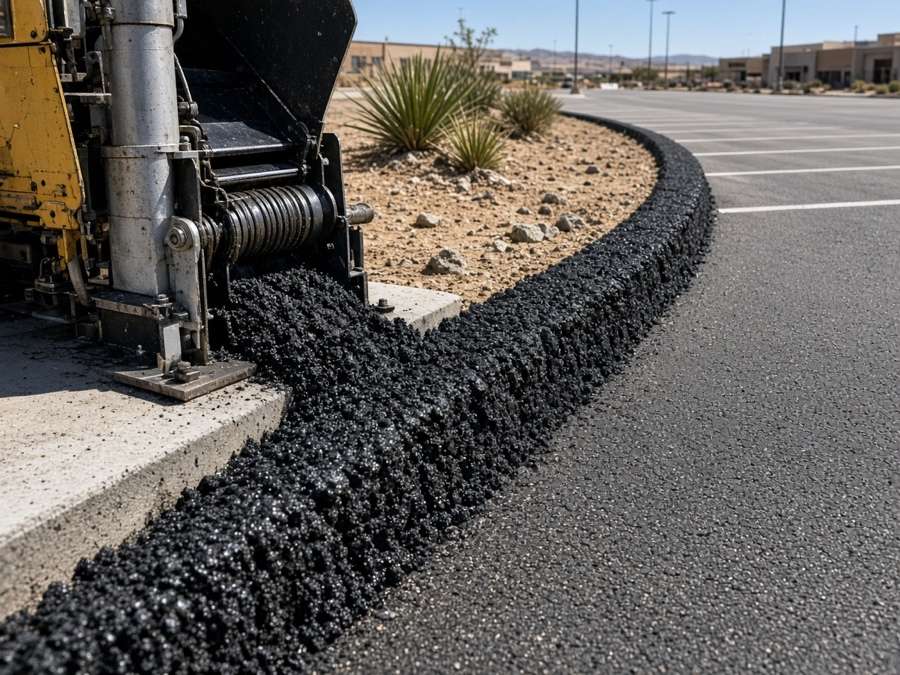
Fire access is a paving spec, not just a paint spec. The access surface has to carry apparatus weighing up to 75,000 pounds, and the lane itself has to stay 20 feet unobstructed, or 26 feet where a hydrant sits along it. On a working Eastvale yard that lane is usually the same asphalt the trucks use, so it gets the heavy section rather than the stall section, and we set the extruded berm and the red curb line so nobody parks a trailer across it. Layout and paint are a separate trade, covered on our parking lot striping and ADA layout page.
New Construction Site Work in Eastvale, a City Built After Its Dairy Years
Eastvale went from a dairy farm enclave to a developed community starting in the 1990s, as the region suburbanized to absorb people moving inland from Orange and Los Angeles counties. That history matters to a paving crew in a practical way. Most of the ground under this city's commercial pads was agricultural before it was anything else, and ground like that can hide soft fill, old service trenches and pockets that were never engineered to carry a building or a truck.
Base Lift Early, Surface Lift After the Trades Leave
On a new pad we work as the subcontractor a general contractor schedules around, and we come twice. The base lift goes down early so the site stays drivable through framing, roofing and the utility trades, which saves the general contractor a mud problem and saves the owner a rutted temporary surface. The final wearing course waits until the other trades are off the property and the punch list is closed, so the surface the tenant sees is not the surface a scissor lift and a concrete pump spent four months parked on. Trench and utility cuts get squared, recompacted and paved flush before that final lift, not patched over afterward.
Grades and Drainage on Former Dairy Ground
The subgrade decides the lifespan, so we proof roll it with a loaded truck and dig out anything that pumps rather than paving over it and hoping. Drainage is the other half. We hold a minimum slope of 2 percent across a lot, and 4 percent where a section has to be hand placed. Our region takes only 9.39 inches of rain a year in Riverside, almost all of it between November and April. A lot that ponds does not get a light annual soaking. It takes the whole year's water in one concentrated stretch, straight into the base.
Phasing a Repave So an Eastvale Retail Center or Business Park Stays Open
A retail center cannot close, and a business park with tenants on leases cannot lose its entrances for a week. So the schedule is part of the scope, written down at bid time rather than negotiated on the first morning. We split a property into quadrants, keep the drive aisles that reach the doors open, and move barricades on a published sequence tenants can post on their own doors.
Night and weekend work is the tool that makes it possible, and it has a hard physical limit. Mix cannot fall below 250 degrees at the paver, and finish rolling has to be done before the surface drops under 150 degrees. That is why a night pour is planned around haul time from the plant instead of around convenience, and why we do not stretch a phase past the point where the mat will still compact. In the other direction, inland heat works for us. Riverside averages 21.6 days a year at or above 100 degrees, and Eastvale sits in the same heat belt. Warm ground buys a longer rolling window on a summer night than a coastal crew ever gets.
Verification travels with the phasing. Caltrans accepts density measured on cores at one per 250 tons placed. Coring what we build is how an owner finds out what was actually delivered, phase by phase, instead of taking a crew's word for it at the end.
A Pavement Budget an Eastvale Property Manager Can Plan Against
Property managers do not buy paving. They buy a defensible line item, approved once a year, that keeps a lot out of an emergency. So we walk each Eastvale property annually and hand back a written condition report: distress mapped by area, square footage attached to each repair, and a plain split between what can wait a budget cycle and what cannot.
The order of operations inside that plan is fixed by what actually fails. Cracks get routed and treated as they open, because water reaching the base is what ends a section early. Alligatored areas are structural, not cosmetic: once that pattern shows, the cracked pavement contributes minimal structural strength, so it is saw cut and rebuilt to base rather than sealed. Seal is a scheduled line, and commercial lots in this market are typically resealed every 2 to 3 years. Sealer protects the surface and restores appearance. It repairs nothing structural and it does not fill a crack, which is exactly why the repair line and the maintenance line stay separate on the budget we hand you.
Commercial asphalt paving is published at roughly $2 to $4.50 per square foot for a standard lot, a Southern California band stated on a Riverside cost page rather than an Eastvale one. Where a given property lands inside that band depends on core results, phasing, night work and how much of the section has to be truck rated. Our written scope comes from a measured on site walk, never a phone description. Full breakdown in our asphalt paving cost guide.
Commercial Paving FAQs From Eastvale Property Owners
How thick should asphalt be for an Eastvale truck court?
Thicker than the stall field in front of it, and the yard should be designed rather than matched. We size heavy duty sections against Asphalt Institute thickness procedures published in IS-91 and MS-1, then add depth at dock aprons and the turning radii where trailers scrub. Cores from the existing pavement tell us what is already there.
Can you pave an Eastvale lot at night while tenants stay open?
Yes, and on most occupied retail and business park properties that is the default. We phase the property so the entrances tenants depend on never close together, and we plan each pour around haul time, because mix has to reach the paver above 250 degrees and be finish rolled before it falls under 150.
Do you need a permit to pave a commercial lot in Eastvale?
Yes, usually. Work inside a private lot, work touching a public street or driveway approach, and work that changes the layout are handled differently, and the requirements come from the city and from the county for anything in the road right of way. We confirm what your specific scope needs and pull the permit rather than leaving it with the owner.
What drives the number on an Eastvale commercial paving quote?
Square footage sets the scale, but four things move it: how much of the property has to be truck rated, what the cores say about existing thickness and base, whether the work is phased or done in one closure, and whether it runs at night. Site amenities like curb, bumps and stops are priced per item.
How soon can loaded trucks use new asphalt in Eastvale summer heat?
Later than cars, and later in July than in November. Passenger traffic returns once the mat has cooled through its depth; loaded trailers and dropped landing gear wait longer, because a warm surface still deforms under a static point load. We give you the specific window in writing for your property before the crew leaves the site.
Get a Free On Site Measurement for Your Eastvale Property
Elite Riverside Asphalt paves, repairs and maintains commercial lots, truck courts and drive aisles throughout Eastvale, from the logistics buildings on the freeway side to the retail centers at the arterials. Call [PHONE] for a free on site measurement and a written scope stating square footage, base treatment, compacted thickness and tonnage. We call back within one business day and get your walk on the calendar this week.