
Asphalt Repair in Jurupa Valley, CA
A driveway out here rarely fails all at once. It fails at the edges, where the mat meets dirt or decomposed granite and nothing confines it, and it fails at the low spot where water stood through a wet winter and never drained off. Elite Riverside Asphalt runs its crew out of Riverside, a short drive up the Santa Ana River, and spends a real share of its week on exactly this work: cutting out the areas that have let go, rebuilding what sits under them, and placing hot mix back so the repair holds past the season it went in. The full method, equipment and diagnosis list lives on our asphalt repair and patching page. This page is about what that work actually looks like on this side of the county line.
Most asphalt contractors quote a hole here the way they would quote one on a suburban tract street, and that is why so many of those repairs come back. Our estimator probes the mat for its real thickness, reads where water runs across the lot, and writes a scope that names square footage, base treatment, compacted thickness and tonnage for each failure area instead of one lump number. We hold the CSLB C-12 Earthwork and Paving classification, the California class covering the mixing, fabricating and placing of paving materials, we carry general liability and workers compensation, and the crew that measures is the crew that paves.


Get a Free Asphalt Paving Quote
Square footage, base condition, thickness and tear-off decide most of your price. Tell us the property address, the job type (driveway, parking lot or repair) and a rough size, and we call back within one business day to schedule a free on-site measurement.
Rural Lots and Long Gravel-Edged Drives on the Jurupa Valley Flats
Jurupa Valley is a young city stitched out of old ground. It incorporated on July 1, 2011, and it is not one settlement but nine: Belltown, Crestmore Heights, Glen Avon, Indian Hills, Jurupa Hills, Mira Loma, Pedley, Rubidoux and Sunnyslope, sitting north and west of the Santa Ana River alongside Eastvale. Those 105,053 residents counted in 2020 are spread across 42.94 square miles, which is the whole story of the pavement here: low density, long approaches, and a lot of asphalt that was never built as a city street.
What that produces is a specific failure pattern. Drives run a hundred feet or more off the road to a house or a barn, and the paving stops at a raw edge with gravel, dirt or a landscape bed on both sides. With no curb or shoulder holding the mat in place, the outer few inches break away under a tire that drops off, then the break walks inward every time a truck swings wide. On the light-industrial parcels through Rubidoux and Mira Loma the same thing happens at a different scale: a yard apron takes loaded axles at the gate, the confined edge crumbles, and the hole that follows sits directly in the path everything drives over.
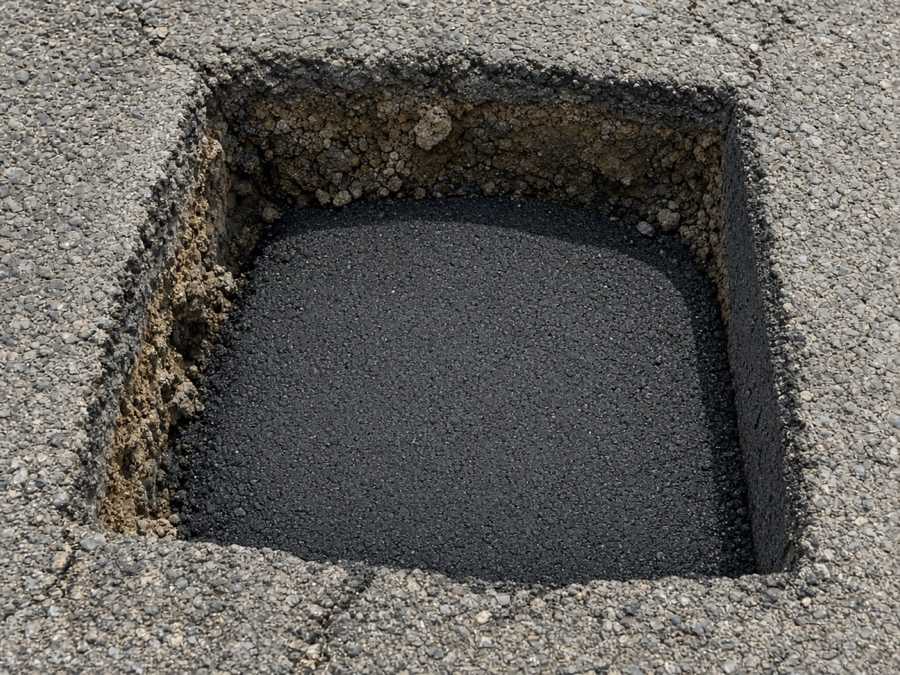
The other pattern is the transition. A lot of these drives are part rock and part pavement, or were converted from decomposed granite one section at a time. Where the two meet you get a lip, a soft shoulder that pumps fines up through the joint, and eventually a raveled band that hides a base problem underneath. Repairing that means restoring confinement, not just filling the gap, which is why we usually cut the failure back to a square vertical face and rebuild the shoulder behind it rather than feathering new material out to nothing.
Saw-Cut Patching Versus the Bag From the Hardware Aisle
The difference between a repair that lasts and one that lasts a season is almost never the asphalt. It is the edge and the compaction. A bagged cold patch goes into a dirty hole with sloped sides, gets tamped by boot or by a hand tamper, and never reaches density. Tires then pump it back out, usually within a few wet weeks. It is not a repair, and no one should be paying a contractor for one.
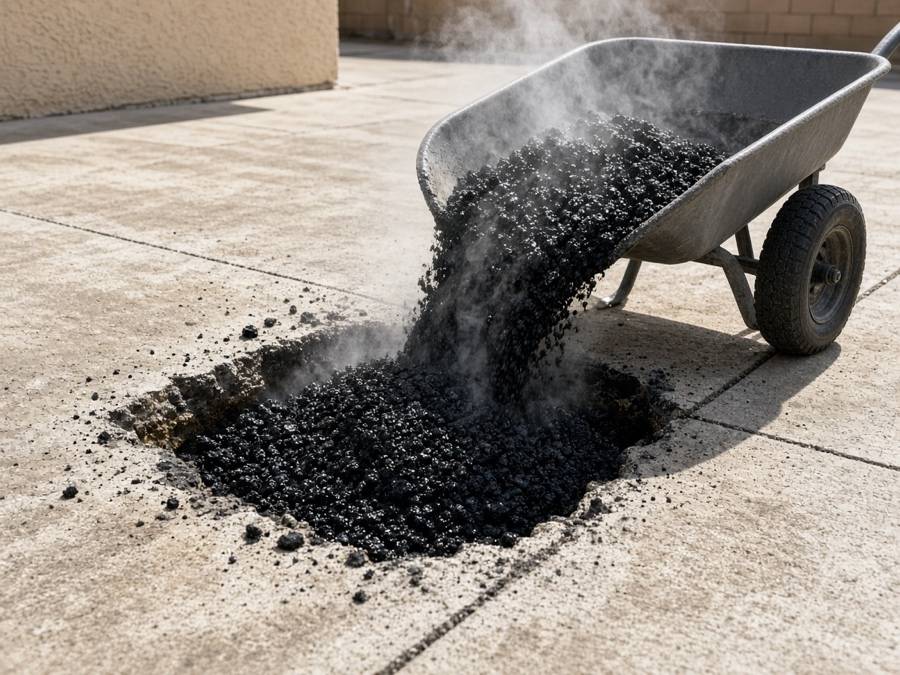
Hire-a-contractor work runs differently. We saw-cut a square perimeter back into sound pavement, break out the failed material and load it out, then look at what is underneath. If the aggregate is saturated or short, it gets removed, replaced and recompacted before any asphalt goes back. The vertical faces get sprayed with tack so the new mix bonds to the old instead of sitting next to it, and the hot mix goes in as lifts, each one rolled to density with a plate compactor or a roller rather than a hand tool. On a driveway we generally cut a section to three or four inches of compacted asphalt; on a yard apron taking trailer loads, deeper.
Water, Clay and the Pothole That Comes Back
A pothole is a crack that won a long argument with water. The crack lets moisture past the surface, the material underneath loses its support, and the next loaded axle punches through. That sequence explains why filling the hole and leaving the base alone buys so little time.
The climate here loads that cycle hard from both ends. Riverside, our home base and the nearest long-record station, averages 21.6 days a year at or above 100 degrees Fahrenheit with a record high of 118. That heat oxidizes binder out of the surface, and an oxidized surface ravels and cracks open. Then the rain arrives in one short run: 9.39 inches a year, almost all of it between November and April. A whole annual water load goes into every open crack inside about five months.
Underneath a lot of parcels in this corner of Riverside County sits expansive clay, which swells when it takes water and shrinks when it dries. A base built on moving ground has to be built for it: proper depth of compacted aggregate, moisture-conditioned and recompacted subgrade, and a surface that actually sheds to daylight instead of ponding. Where a pan is flat enough to hold water after a storm, we say so at the estimate, because regrading the low spot is the repair. Patching over it is a receipt.
Season matters too. Riverside County holds its own seal work to a window that closes by the end of October, and the same logic applies to your lot: base repair goes in far better before the wet season than during it.
Trip Hazards on Private Property, and Who Fixes the Street
A pothole in a public street is a report to the agency that owns the road, not a call to a paving crew. Work in the county road right of way is permitted separately, through the county's own encroachment process, and we pull what a job needs when a repair touches it. Everything inside the property line is ours: the driveway, the ranch approach, the church or school lot, the yard apron, the private road a group of neighbors shares.
Private property is also where the liability sits. A raised lip at a walkway, a sunken stall in front of a door, or a hole where a tenant parks is a claim waiting for a rainy morning. Those get a same-day response from us, and most private repair work in this city goes on the schedule inside the same week rather than into a queue.
Repair pricing follows the failure, not square footage alone. Statewide California cost reporting puts asphalt patching at roughly $3.00 per square foot, a California average rather than a quote for your lot, and depth, access and the number of separate areas move it hard in both directions. Our asphalt paving cost guide breaks those drivers apart.
When Patching Is Not the Answer for a Jurupa Valley Lot
Sometimes the honest answer at the estimate is that repair is the wrong product. When cracking has spread into the interconnected hide pattern across most of a surface, the structure below has fatigued and cutting out individual areas turns into cutting out the whole thing. At that point asphalt resurfacing, overlay and milling over a sound base, or a full-depth rebuild where the base is gone, is the work that actually holds.
The opposite call is just as common. A surface with narrow, isolated cracks does not need a patch crew at all; it needs crack sealing and filling before this winter drives water into the base and turns a small job into an expensive one.
Asphalt Repair Questions From Jurupa Valley Property Owners
Can a broken asphalt driveway in Jurupa Valley be repaired?
Yes, when the failure is localized and what sits beneath it is still sound. We remove the failed areas, replace poor material underneath, correct the drainage that caused it and patch back to grade. The deciding questions are how much of the surface has alligatored and whether water has already reached the layers below.
Will a Jurupa Valley patch bond to the old asphalt around it?
Yes, with a saw-cut face and a tack coat. Fresh hot mix bonds to aged pavement through a sprayed asphaltic emulsion applied to a clean, dry vertical edge, which is exactly what a sloped, dusty hole cannot give it. Skip the cut or skip the tack and the joint opens within a season, usually right where a tire crosses it.
Should I repair or replace a failing rural driveway here?
Base condition decides it, not age. Isolated holes, sunken spots and edge breakage on an otherwise solid mat are repair work. Widespread interconnected cracking, water standing after every storm, and sections that visibly move under a vehicle mean the structure has failed and a rebuild is the durable answer. We probe the mat and the base before recommending either.
What is the most durable way to fix a pothole on a rural lot?
Full-depth removal and replacement. Cut a square perimeter into sound pavement, dig out the failed asphalt and the compromised material below it, recompact or replace that layer, then place hot mix in lifts and roll each one to density. Nothing shallower survives a summer of heat cycling followed by a winter of concentrated rain on expansive clay.
Do you repair potholes in public streets?
No. Public roads belong to the agency that maintains them, and street potholes are reported to that agency rather than to a contractor. We work on private property: driveways, ranch approaches, shared private roads, church and school lots, commercial parking areas and industrial yard aprons.
Get a Free On-Site Measurement in Jurupa Valley
Elite Riverside Asphalt covers asphalt repair across Jurupa Valley, from a single pothole at a gate to a full-depth rebuild of a yard apron. Call [PHONE] for a free on-site measurement and a written scope naming the method, the base treatment, the compacted thickness and the tonnage for every area we touch.