
Commercial Asphalt Paving and Parking Lots in Riverside, CA
Elite Riverside Asphalt holds the CSLB C-12 Earthwork and Paving classification, which covers the mixing, fabricating and placing of paving and surfacing materials. Commercial asphalt paving is lot scale work: a measured hot mix section over a compacted aggregate base, placed to Caltrans Standard Specifications Section 39, then finished with the parking lot paving details, striping and accessible stalls that have to survive review under the 2010 ADA Standards for Accessible Design.
Owners usually call us at the point the lot is already costing them money: alligatored drive aisles, a settled utility trench at the entrance, faded stalls, an accessible space that would not pass an inspection, and a tenant asking when it gets fixed. Riverside sits at or above 100 degrees roughly 21.6 days a year, so a neglected surface oxidizes and ravels fast here. Every summer of waiting pushes the job further from resurfacing and routine pavement maintenance toward a full depth rebuild, which is the expensive version of the same decision.

Get a Free Asphalt Paving Quote
Square footage, base condition, thickness and tear-off decide most of your price. Tell us the property address, the job type (driveway, parking lot or repair) and a rough size, and we call back within one business day to schedule a free on-site measurement.
Commercial Paving and Parking Lot Types We Handle in Riverside

Parking Lot Paving and New Construction Site Work
A bare pad starts with subgrade excavation and a proof roll: we run a loaded truck across the graded soil and dig out anything that pumps or ruts before base goes down. Class 2 aggregate base follows, spread and compacted in layers, then the mat. Our standard car traffic section is roughly 4 inches of hot mix over 6 to 8 inches of that base, built in two lifts rather than one pour. That is not preference. Caltrans requires a section of 0.30 foot or more to go down in lifts of not less than 0.15 foot each with a tack coat between them. On new construction we place the base course before final grade so the site stays drivable while the building trades work, then return for the surface course once they are off site and the punch list is closed.
Parking Lot Repair and Pavement Restoration
Four things fail on a commercial lot and each is a different repair. Alligatored drive aisles are structural: once that pattern shows, crack sealing is generally ineffective and the cracked pavement contributes minimal structural strength. Those areas are saw cut, dug to subgrade and rebuilt with base and hot mix. A failed dumpster pad takes a static load plus steel wheel drag, so it comes out full depth and goes back deeper. A settled utility trench is a backfill problem, so we cut a square edge past the settlement, recompact and pave flush. Ponding at a drain is regraded to the inlet, not skimmed. Our full depth patches run the depth of the original section plus whatever base repair the core calls for. The methods themselves are covered on our asphalt repair and patching page.
Asphalt Curbing and Parking Lot Curb Repair
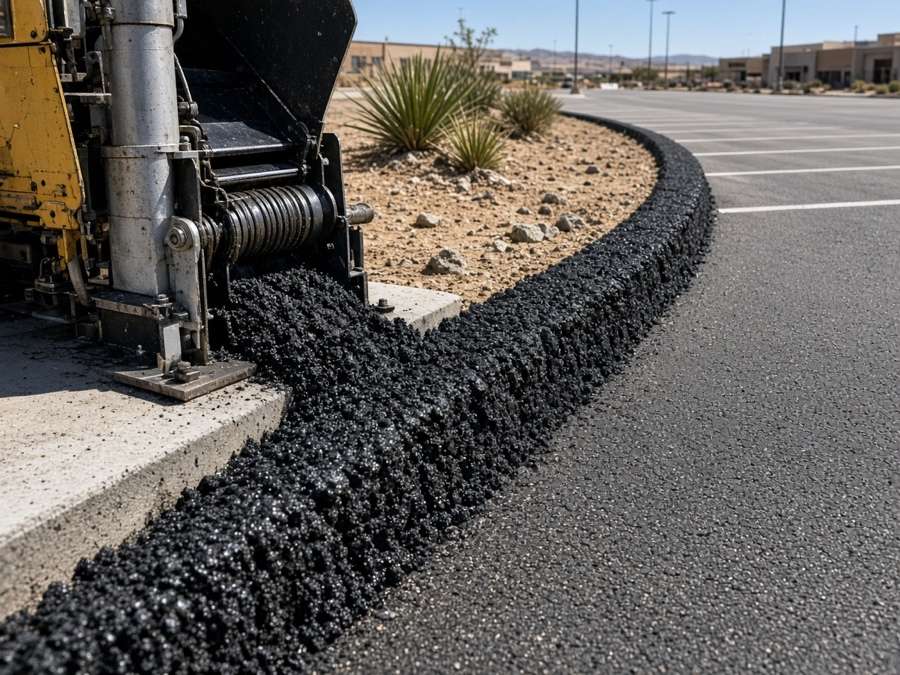
Extruded curb is laid by a curb machine that pushes a continuous berm onto the finished surface, so an island edge or a drainage channel forms in one pass with no forms and no separate crew. Our standard profile stands about 6 inches with a sloped face that steers water toward the inlet and absorbs a tire hit without spalling. A damaged run is cut out and re-extruded to match; a hairline separation at the pavement joint is tacked and patched instead. This is asphalt curbing, not concrete flatwork, which we do not sell. Fire lane painting is the companion item. Red means no stopping, standing or parking under CVC 21458. That curb line is what keeps the 20 feet of unobstructed fire access clear, or 26 feet where a hydrant sits on the road.
Speed Bump and Speed Hump Installation
The three devices are not interchangeable, and the difference is length. A speed bump stands 3 to 6 inches high with a travel length of 1 to 3 feet and drops vehicles to 5 mph or less, which is why it belongs on private roadways and parking lots. A speed hump is 3 to 3.5 inches high, 12 to 14 feet long, holds about 20 mph and is a residential street device. A speed table is 3 to 3.5 inches high and 22 feet long with a 10 foot plateau, giving 25 to 30 mph. We form ours in hot mix off the paver, hand rake to a template and roll while the material is workable, bonded down with tack. Yellow paint and an advance BUMP legend on the approach are what make one visible at night. A private lot sets its own placement; a public street does not work that way.

Heavy Duty Truck Yard and Warehouse Paving
A loaded trailer resting on its landing gear is a static point load parked in one spot for days, which is a harder problem than rolling traffic and the reason a car lot section shears at a dock. Our heavy duty section runs 5 to 6 inches of mat over 8 to 12 inches of Class 2 base, deeper again at dock aprons and on the turning radii where trailers scrub. We follow Asphalt Institute heavy duty design practice, whose thickness procedures are published in IS-91 and MS-1. The fire code gives a truck court a useful sanity check: an access surface has to carry apparatus weighing up to 75,000 pounds. Layout matters as much as depth, so we keep the dock approach flat enough to land gear squarely and crown the yard away from the building.
Parking Lot Maintenance Programs for Property Managers
A program is a calendar, not a phone call. We inspect annually and hand the owner a written condition report: distress mapped by area, square footage priced for each repair, and a clear split between what can wait a budget cycle and what cannot. Joints and cracks get routed and treated as they open, because water reaching the base is what ends a section early. Seal is a scheduled line on that calendar, and commercial lots here are typically resealed every 2 to 3 years. Fresh markings go back on the same closure. Seal protects the surface and restores how it looks. It repairs nothing structural and it does not fill a crack, so alligatored areas belong on the repair line of a Riverside budget rather than the maintenance line. What the application involves is covered on our asphalt sealcoating page.
Our Commercial Paving Process, From Site Survey to Reopening the Lot
Site Survey, Traffic Phasing and Night Work Scheduling
Every scope starts with a measured takeoff and a core, because coring is how a section gets read. Caltrans accepts density on cores, one per 250 tons placed. We phase the lot so tenants keep access, working nights or a weekend where a business cannot close. Right of way work carries a traffic control plan and a street opening permit, usually 7 to 10 business days.
Grading, Base Compaction and Parking Lot Drainage
Parking lot grading decides whether the base ever stays dry. We hold a minimum slope of 2 percent, or 4 percent where a section is hand placed. Birdbaths and ponding are cut out and regraded into the nearest area drain or catch basin tie in, never skimmed over. Aggregate base is compacted to at least 95 percent relative compaction before any mat goes down.
Paving Lifts, Compaction and Reopening the Lot
Mix cannot fall below 250 degrees at the paver, and finish rolling is done before the surface drops under 150 degrees. Behind the screed come three vibratory coverages, three pneumatic coverages at no more than 5 mph, then one steel tired finish pass. Two lifts beat a single thick pour because a roller cannot reach that far down. Cars return once mid depth falls under 160 degrees, loaded trucks later, and both windows stretch in Riverside summer heat.
Materials and Equipment We Use on Commercial Lots
Commercial Hot Mix Designs and Aggregate Base
A lot takes two mixes: a coarser base course and a finer surface course. Caltrans ties that choice to lift thickness, calling for 1/2 inch aggregate on a lift of 0.15 to under 0.20 foot and 3/4 inch above it. Class 2 aggregate base sits under both. Our conventional binder is PG 64-10. Haul time from the Inland Empire plant decides what temperature the load arrives at, and temperature decides compaction.
Wheel Stops, Bollards and Traffic Signage Hardware
Wheel stop installation is a pinned job: each stop is drilled into the mat and held 2 to 3 feet back from a wall, building or fence so overhang clears. Bollards go where a vehicle can reach something costly, at storefront doors, gas meters and dock corners. Stall and fire lane signs are set with the layout. Stops, signs and markings fall under CSLB C-32, not C-12 paving.
Why Riverside Property Managers Choose Us for Commercial Paving
- CSLB C-12 Earthwork and Paving licensed, liability and workers comp carried
- Our own paver, vibratory and pneumatic rollers, no subcontracted crews
- Commercial paving services phased at night so your tenants stay open
- Written scope with measured square footage, base depth, thickness and tonnage
- Written workmanship warranty on full depth work, condition report each year
- Free on site measurement and a callback within one business day
What Affects the Price of Commercial Paving in Riverside
Lot Size, Square Footage and Job Phasing
Commercial paving across Southern California runs about $2 to $4.50 per square foot, and $5 to $12 or more on a very small lot. The rate falls as square footage grows, since mobilization and a crew day are close to fixed, then climbs when the job is split into phases or night shifts. See our asphalt paving cost guide.
Pavement Thickness and Traffic Loading
A lot is not one pavement. Stalls and access lanes are light load; entrances, exits, store frontage and truck loading areas are heavy load. Between them we add about an inch and a half of mat and several more inches of base, a second paving pass. A bid quoting one thickness everywhere overpays on stalls or underbuilds the entrance.
Existing Pavement Condition and Subgrade Failures
A core reports real thickness, base condition and whether it was ever compacted. Fatigue cracking traces back to loss of base or subgrade support. A settled trench means a rebuild to grade there, not a surface course, and the cores decide how much of the lot. Where base is sound, asphalt resurfacing, overlay and milling costs less.
Curbing, Speed Bumps and Site Amenities
Curbing, wheel stops, bollards and bumps are priced per item, which is why they belong on the same mobilization as the paving. A separate trip for a handful of stops carries the same truck, crew and traffic control as a whole lot. Layout, paint and accessible stall upgrades are quoted on our parking lot striping and ADA layout page.
FAQs About Commercial Paving and Parking Lots
How many inches of asphalt do you need for a parking lot?
Car areas get about 4 inches of compacted asphalt on 6 to 8 inches of Class 2 base. Truck areas get 5 to 6 inches on 8 to 12 inches of base. Caltrans caps any compacted lift at 3 inches, so the deeper section is placed in two passes.
Is concrete or asphalt better for a parking lot?
Asphalt, for nearly every commercial lot in this climate. It reopens the same day it is placed, and a failed area is cut out and rebuilt in place instead of replacing and matching a slab. Concrete earns its keep only where trucks sit still, at dumpster pads and dock aprons.
How thick should asphalt be for heavy trucks?
Five to six inches of compacted hot mix over eight inches or more of Class 2 base, thicker again at dock aprons and turning radii. The reason is static load. A parked trailer presses its landing gear into one spot for days, which punishes a mat far more than rolling traffic does.
Do you need a permit to pave a parking lot?
Yes, usually. A City of Riverside Public Works Construction Permit covers work preparing subgrade, paving, and constructing curbs, gutters, driveways and sidewalks, and requires a licensed contractor and traffic control plan. A like for like resurface usually differs from a new lot or a changed layout. We confirm current requirements and pull it.
Should a parking lot be restriped when it is resealed?
Practically speaking, whenever the surface is resealed. The lot is already closed, fresh sealer holds new markings better and you pay for one closure instead of two. Heat and ultraviolet exposure in Riverside fade markings faster than traffic alone does, so entrances and drive aisles come due before the outer stalls.
What does parking lot maintenance entail?
Inspection, crack routing and treatment, patching what has already failed, keeping drains clear, sealer on a set cycle and fresh markings. Hot pour rubberized sealant handles cracks up to 3/4 inch. Sealer protects the surface and restores appearance. It repairs nothing structural and does not fill cracks, so failures still come out to base.
Get a Free Commercial Paving Estimate in Riverside
Elite Riverside Asphalt paves, repairs and maintains commercial lots, truck yards and drive aisles throughout Riverside. Call [PHONE] for a free on site measurement and a written scope stating square footage, base depth, compacted thickness and tonnage. Ask for the pavement condition report, or contact us to get on the schedule.